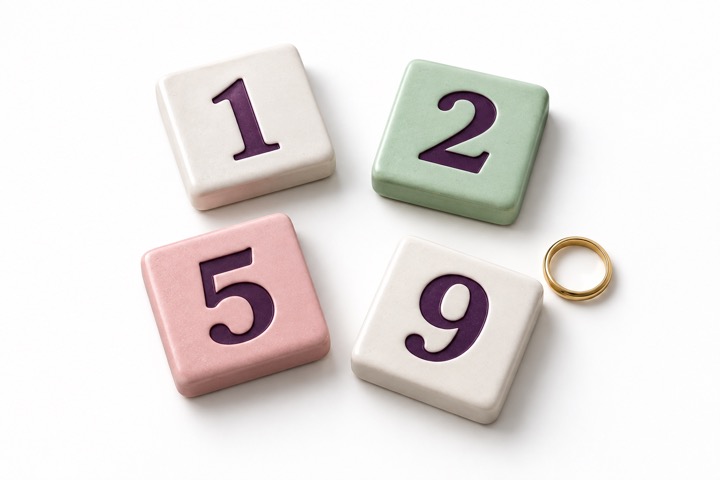
Some number puzzles ask you to fill a grid or follow a sequence. Make 10 has a different, smaller goal: choose two tiles whose numbers add up to ten. All the numbers are visible, and the tiles can be anywhere on the board. You do not need to draw a path or move them beside each other.
This makes it easy to begin with just one question. Pick a number, then ask what is missing from ten. If you select a 3, look for a 7. If you select an 8, look for a 2. Finish each small decision before scanning for the next pair.
Keep five combinations in mind
With values from 1 to 9, the combinations are 1 + 9, 2 + 8, 3 + 7, 4 + 6, and 5 + 5. The order does not matter: selecting 9 and then 1 makes the same total as selecting 1 and then 9.
You do not have to remember the whole list at once. Subtract your first number from ten and look for the result. The playable puzzle also tells you which partner to find after your first selection, so you can check your thought before tapping again.
Work through a smaller board
This original eight-tile example uses the same matching rule as the sixteen-tile game. The large numbers are values; the small corner numbers identify positions.
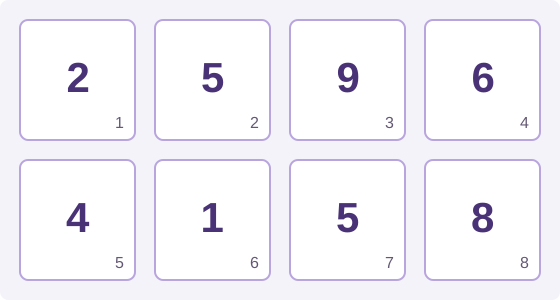
Find four pairs. Tiles do not need to touch each other.
Start with the 2 at position 1. Its partner is the 8 at position 8. Those tiles are on opposite sides of the board, but that is allowed. Marking them leaves six tiles, and none of the remaining tiles changes position.
Next, choose the 9 at position 3 and the 1 at position 6. Their total is ten. The 6 at position 4 goes with the 4 at position 5, leaving two separate 5 tiles at positions 2 and 7. Together, those make the final pair.
Two fives means two tiles
A 5 needs another 5. Tapping the same tile twice is not a pair because you would be using one tile twice. Choose a second position with the same value.
The larger playable board also repeats some other values. When there are two 2s and two 8s, either 2 can match either 8. Do not spend time searching for a special hidden partner. The rule checks the values, not which duplicate you chose.
Why a correct pair cannot trap this board
Puzzlepia’s fixed board starts with balanced partners: each 1 has a 9, each 2 has an 8, and so on, with an even number of 5s. Removing a valid pair takes away one of each needed value. The remaining tiles therefore still have partners.
That reasoning applies here because there are no adjacency or path restrictions. Another number game may require neighbouring tiles, connecting lines, or a particular order. Read its rules before carrying this strategy across. A familiar-looking grid does not always mean the same puzzle.
Recover from a different total
If you choose 6 and 3, the game shows that the sum is 9. Nothing is removed. Your next tap clears that attempt and begins another pair. You can also press Clear selection and start with a different first tile.
There is no timer, score deduction, or limited number of tries. Reset restores the full original board, including all matched tiles. After completion, you can play the same layout again; this starter does not generate a fresh puzzle each day.
Choose your next number break
Try the smaller Find Every Pair That Makes 10 challenge before opening the full Make 10 board. For an ordering task instead of addition, Daily Number Puzzle asks you to tap 1 to 16.
Prefer symbols? Memory Pairs hides its cards and asks you to remember locations. Both starters are available in Daily Puzzles, while the Games hub introduces other puzzle styles. Choose the rule that suits the break you have, rather than rushing to finish every game.