A memory matching game begins with a small mystery: which two cards share a picture? The rule is simple, but it is easy to remember seeing a star and forget where it was. A useful starting habit is to connect each picture to a place, rather than trying to hold a list of pictures in your head.
Puzzlepia’s Memory Pairs gives you twelve cards and six symbol pairs. It is untimed, and the layout stays the same when you reset. That makes it a comfortable place to practise a method without also learning a new board on every attempt. The aim is simply to find every pair, not to beat a speed target.
Give the board a simple address system
Think of the board as rows and columns. “Star, top left” is a more useful note than “I saw a star.” On a wider board, you might use “second row, third card.” Choose whichever description comes naturally; the words do not need to be formal.
Our playable cards also have small position numbers. Those numbers identify places, not pairs. Card 2 does not necessarily match card 12. Match the large symbols you uncover, and use the small numbers only to remember their locations.
Try this eight-card example
The example below is a teaching board, separate from the twelve-card game. All eight faces are shown so you can check a sequence of moves.
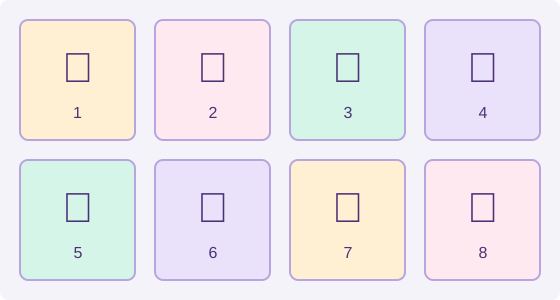
Match symbols, not position numbers. Each symbol appears twice.
Imagine you first turn over cards 1 and 2. They show a star and a moon, so they are not a pair. Instead of treating that as a wasted move, keep two short notes: star at 1, moon at 2.
On your next turn, card 7 reveals a star. You already know its partner: card 1. Choose that known location rather than opening another unknown card. The matched pair can stay face up, leaving fewer places to consider.
Later, card 8 shows a moon. The earlier mismatch now helps again: choose card 2. A single unsuccessful reveal has contributed to two successful pairs.
Let mismatches give you information
When two pictures differ, pause long enough to notice both locations. In Puzzlepia’s game, a mismatch stays visible until your next card tap. You are not racing an automatic flip timer. Your next tap hides the mismatch and starts a fresh pair, or you can use Clear selection first.
It can help to explore one small area at a time. For example, inspect the upper row before jumping between every corner. This is an optional habit, not a rule or a guarantee of fewer attempts. The best approach is one that lets you describe what you just saw.
Avoid revealing the same card twice
Two different cards are needed for a match. Tapping an already selected card does not count as finding its partner. Look for a second location, even if the symbol is familiar.
Also separate a remembered fact from a guess. “I saw the sun at 5” is different from “perhaps the sun is near the bottom.” When you are unsure, it is fine to explore. There is no penalty or lost life in this starter, and a mistaken choice does not make the board unsolvable.
Finish, reset, or change the pace
The remaining pairs in the example are 3 with 5 and 4 with 6. Every card belongs to one pair. A finished board has no unmatched cards left, not just the first pair you recognised.
Try Remember the Star Pair for a short look-and-recall exercise, then play Memory Pairs. Reset restores the same board, so a second completion is a chance to practise familiar locations, not a new difficulty level.
For a different kind of matching, Make 10 keeps every number visible and asks you to find totals instead of remembered symbols. You can browse Daily Puzzles and Puzzlepia Games whenever you want a different kind of break.